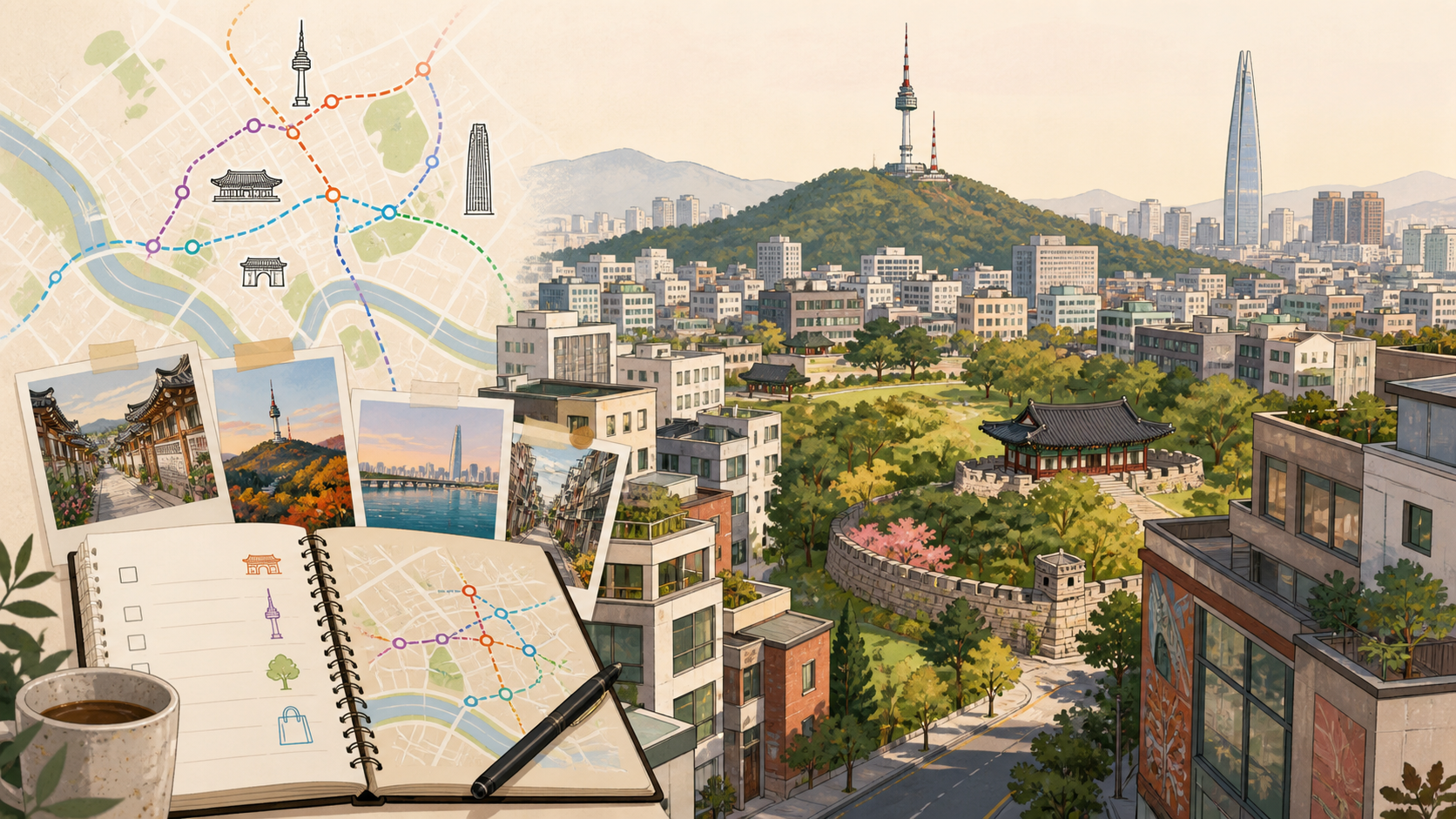
Choosing a Seoul hotel is easier when you stop asking which neighborhood is “best” and start with the journeys you will repeat. Seoul is large, late transfers feel longer than they look on a map, and two hotels with the same district name can create very different daily routines. For a first visit, choose the base that removes friction from your most important days.
Choose by the journeys you will repeat
Write down three anchors: how you will arrive, the two areas you expect to visit most often, and what you want close to the hotel after dinner. A traveler landing late at Incheon Airport has different priorities from someone taking an early KTX, and a visitor focused on palaces needs a different base from someone spending evenings around Hongdae.
Check the full route rather than the straight-line distance. A short map distance can still involve a wide road, a station with long internal corridors, stairs, or a steep final block. Search the exact hotel entrance and the station exit you expect to use. If you have large luggage, confirm whether an elevator is available on that route and keep a taxi fallback for the arrival day.
Compare the main first-trip bases
| Area | Works well for | Main trade-off |
|---|---|---|
| Jongno and Gwanghwamun | Palaces, traditional neighborhoods, museums and a quieter evening rhythm | Some late-night dining and shopping plans require another ride |
| Myeongdong and Euljiro | Central sightseeing, shopping, airport-bus options and flexible subway access | Busy streets and room sizes can vary sharply by building |
| Hongdae | Airport Railroad access, cafés, nightlife and a lively independent trip | Less convenient for repeated palace or southeast-Seoul plans |
| Seoul Station | AREX arrivals, early KTX departures and short transit-heavy stays | The immediate surroundings are practical rather than the strongest evening destination |
| Gangnam and Jamsil | Business, conventions, concerts and plans concentrated south of the river | Longer cross-city journeys for many historic sights |
These are starting points, not rankings. If most of your itinerary sits east or south of the river, staying centrally in northern Seoul may add unnecessary transfers. If your plans are scattered, a hotel near a useful interchange can matter more than a famous neighborhood name.
Plan the airport arrival before booking
Compare the Airport Railroad, airport limousine bus and taxi using your actual landing time and luggage. The train can be predictable, but the last walk matters. A bus may reduce transfers when it stops near the hotel, although road traffic affects arrival time. A taxi can be the simplest choice late at night or for a group, but the route and cost vary with traffic and destination.
Do not assume a hotel advertising “airport access” has a door-to-door service. Confirm the current stop, operating hours and walking route through the operator or hotel. The official Incheon Airport website provides current airport transport information, while the Visit Seoul transportation guide is useful for understanding the city network.
Check the room as a working space
Room category names do not tell you whether two suitcases can open at the same time. Look for the published floor area, bed width, bathroom layout and recent room photos. Couples should confirm whether “double” means one bed and whether a twin room can be guaranteed. Families should verify occupancy rules for the exact room, not assume that a child can share an existing bed without restrictions.
Also check heating and cooling control, window type, blackout curtains, laundry access and refrigerator size if they matter to your stay. These details have more effect over four or five nights than a lobby photograph. Ask the property directly when the booking page does not clearly state a policy.
Test the evening around the hotel
A good first-trip base should still work when you are tired. Open the map around the hotel and look for a convenience store, a simple meal, a café for breakfast and a well-lit return route. Check weekday and weekend hours separately. A district can be lively two blocks away while the hotel’s own street becomes quiet early.
Travelers who value nightlife should examine the last part of the return journey, including the last train and realistic taxi pickup points. Travelers who sleep lightly should check whether the room faces a nightlife street, elevated road, railway or construction site. Recent guest comments can reveal patterns, but separate repeated observations from a single complaint.
Use a booking checklist
- Map the arrival route from the airport or station to the actual entrance.
- Count transfers to the two places you will visit most often.
- Confirm room area, bed arrangement and maximum occupancy.
- Read the cancellation deadline in the hotel’s local time.
- Check luggage storage before check-in and after checkout.
- Confirm breakfast hours only if they fit early tours or departures.
- Save the hotel name, address and phone number in Korean for taxis.
Keep one alternative hotel in the same area. If the first choice becomes expensive, the alternative should preserve the same transport logic rather than force you to redesign the trip.
Who should choose which base?
Choose Jongno or Gwanghwamun when historic Seoul is the center of the trip. Choose Myeongdong or Euljiro when you want a flexible central base and expect to move in several directions. Choose Hongdae when airport access and evening energy matter. Choose Seoul Station when the stay is short and rail logistics dominate. Choose Gangnam or Jamsil when work, events or southeast-Seoul plans account for most of your time.
The final decision should be made from your dates, room terms and exact route. Hotel services and transport operations change, so recheck the live information shortly before travel.
Sources checked
Transport and destination planning were checked against the official Visit Seoul, Korea Tourism Organization and Incheon Airport websites. Always verify schedules and property policies for your travel date.
Editorial note: Korea Staybook compares travel decisions independently. If a verified partner link is added later, it will be clearly identified and will not change the editorial conclusion. Last reviewed September 2026.